Flora’s Diary
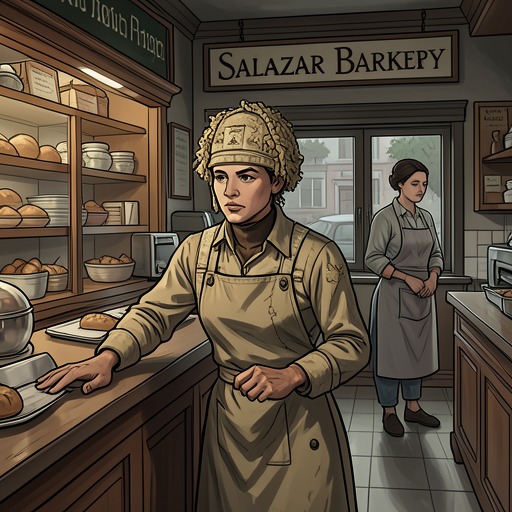
Ofrenda a la tormentaFlora’s Diary is a concealed record at the center of a confrontation between Flora and Ros. Its significance lies not in any passage quoted or disclosed to the reader, but in what Ros says she has learned from it: the diary makes Flora vulnerable to exposure over a death, while its preservation gives Ros a way to protect herself and force a change in ownership of the bakery.
Concealment and Discovery
Flora keeps the diary in a safe hidden behind a painting in the bakery’s storeroom office. At two in the morning, she returns to retrieve it before Ros notices it is missing. The storeroom entrance is usually dark, and Flora has long wanted a streetlight there; because the ground is privately owned, the town council has resisted installing one. She waits until she reaches the office to switch on the lights, then climbs onto the sofa, removes the painting, and opens the safe with a code she devised herself.
The safe is empty. Flora checks its metal interior by hand, and her alarm gives way to panic when Ros speaks behind her. Ros explains that she had noticed the painting slightly askew after Flora entered the office while Ros was away. She did not know the code, but, as the bakery’s owner, she could summon an expert to open the safe. The diary has thus been discovered not through a breach of its mechanism but through Ros’s attention to a small disturbance in the room and her authority over the premises.
What the Diary Reveals
Ros says she has examined the contents of the safe repeatedly, read the diary, and understood it. The scene does not reproduce the diary’s text or set out its entries, so its precise account remains undisclosed. Ros’s response nevertheless establishes the stakes: she refers to Flora’s role in what happened to a man who died at a farmhouse, and contrasts that death with the conduct of her own lazy husband, who, she says, killed no one. Her reference to complicity makes the diary dangerous as a possible record of what Flora knew and did.
Ros also recognizes the moral pressure the diary carries without presenting herself as a judge. She tells Flora that she understands why she acted, and that she does not reproach her; at the same time, she rejects Flora’s claim to superior morality. The diary therefore functions both as a record of a concealed past and as the basis for an argument about responsibility. Ros’s understanding does not erase the possibility of legal exposure, and her sympathy does not mean she will surrender control of the evidence.
Ros’s Safeguard and Demand
Before confronting Flora, Ros has removed the diary and the red shoes from the safe and placed them in a box with a notary. She has made a testamentary provision that, if anything happens to her, an envelope is to be delivered to their sister Amaia. Ros says she is young and healthy and does not expect to die soon, but the provision gives the hidden materials a route beyond her own possession. The threat is conditional: Ros does not say that she has already sent the diary to Amaia, but makes clear that Flora cannot assume the evidence will disappear if Ros is harmed.
Ros uses that leverage to demand Flora’s share of the bakery. She proposes that they go to another notary and arrange a donation transferring Flora’s portion to her; Flora may take her money and live her own life, and Ros says she will not otherwise pursue the matter. If Flora refuses or retaliates, Ros warns that she will respond by exposing her. The diary’s custody has therefore changed the sisters’ balance of power: Flora came to recover it, but Ros turns its continued safekeeping into the means of negotiating ownership.
Narrative Role
The diary remains unseen as a text, yet its effects are concrete. Its hidden location, the displaced painting, the empty safe, and the red shoes kept alongside it give the secret a material form without revealing every detail of its contents. Ros’s repeated reading makes clear that the record has been weighed and interpreted, while the notary and the provision for Amaia convert private knowledge into a contingency that may outlast the confrontation.
The scene leaves the diary’s exact wording and Flora’s response to Ros’s demand unresolved. What it establishes is the record’s double force: it may expose Flora, but its preservation also allows Ros to set terms rather than simply accuse her. In this way, a private document becomes a tool of family coercion, a possible safeguard against silence, and the hinge on which control of the bakery turns.